

Understanding your emotions, and learning to manage them, is a great advantage when investing. Much of portfolio theory and investment research is based on what a rational person would do. But people are not rational, particularly when it comes to their money.
Nobel prize winner Daniel Kahneman and Amos Tversky studied risk behavior and applied it to the economics of investing. Their research forms the basis of behavioral finance and how people apply mental shortcuts to investing as opposed to an analytical and deliberate strategy. Being thoughtful about your investing, even when you are afraid, can lead to long-term gains.
Let’s focus on the emotional side of portfolio management.
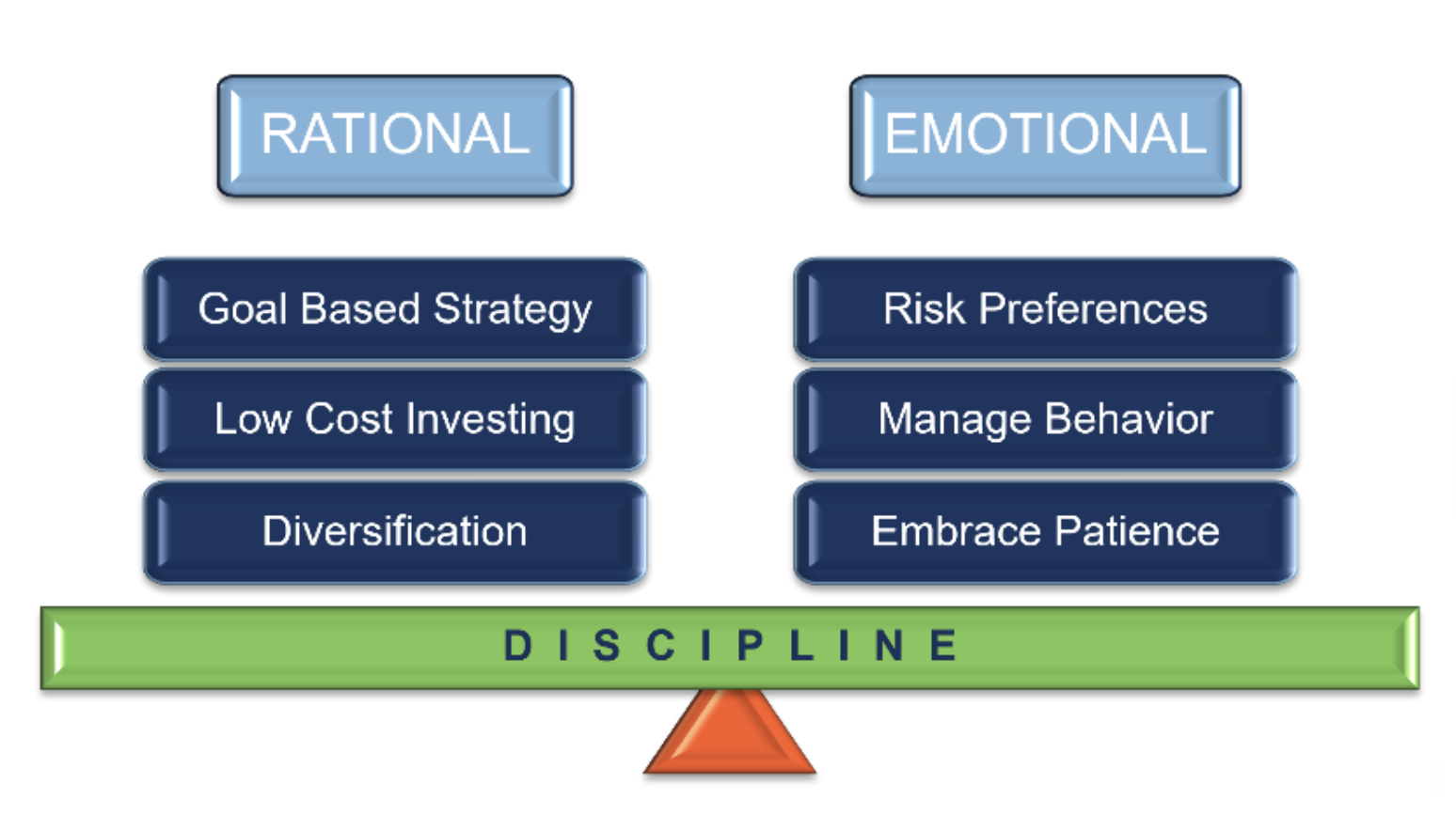
Risk Preferences
Before investing, we spend time discussing your comfort level with risk so we can better understand how you may react under different market circumstances. This is where your emotional response to the ups and downs of the market really come into play. When markets fall and you are excited because you have an opportunity to invest, you probably have a high risk tolerance. If you get scared during market downturns and feel like the sky is falling, you are most likely in the low tolerance category.
Additionally, we consider your timeline for investing. If you need short-term funds, we would want to invest conservatively, or make sure you have cash on hand. For longer term needs, we may invest more aggressively.
Another part of your risk profile is your capacity for investing. Think of this as how much you can afford to lose. For example, if you are retired with a small income and only $100K in investments, you may want to be conservative as you cannot afford to lose those funds. On the other hand, suppose you have a large steady pension along with Social Security and real estate income. If you have the same $100K in savings, you may be able to invest more aggressively as a loss would not have the same negative impact.
Finally, education helps you become comfortable with stocks and investing. Learning increases your understanding and your comfort with the risks in all markets.
Manage Behavior
Our behavior often works against us when investing.
When we listen to the news headlines, we might hear that stocks are going to soar this year. Or, more often, the markets are going to crash. Maybe you feel like you have a strong insight into a particular business sector, so you focus only on those stocks. These ideas make us want to buy or sell in an attempt to take advantage of the business cycle. However, this is hard to do.
You need to manage your emotions when you are investing. Focus on the things you can control, not on markets and news. Don’t worry about how a stock performed yesterday. It may react very differently today.
A client told me that when Trump was first elected president, she sold out of the markets because she was afraid everything would crash. Stock markets were booming. So, when Trump was elected for his second term, she felt like the economy would be great, so she purchased tech stocks. The magnificent seven declined about 11% in his first 100 days. Her emotions failed her investing decisions.
It’s difficult to decide the right time to sell out of stocks during a business cycle. Often, we see clients sell out of fear. When clients want to do this, we have to ask: if you get out now, how will you know the right time get back into the market? It’s even more difficult to determine when to buy back in. Essentially, you would need to be correct twice without the benefit of hindsight. By having a diversified portfolio calibrated to your big picture goals, you do not need to focus on market timing.
One of the benefits of being well diversified is not having to react to markets. We encourage our clients to tune out the noise they hear from the media and pundits and continue on their current investment track.
One tool we use to keep your portfolio on track is a simulation of your investment results with hundreds of potential variables. This allows us to factor market changes into your investments so you can be more confident that your plan will withstand daily volatility changes, regular market price pullbacks, and random catastrophes. Your plan is built to withstand those. While we don’t know exactly what it will look like next time the market is shaken by volatility, we do know it will happen and we have a plan for it.
Embrace Patience
Investing and trading are two different activities. Investing is boring – like watching paint dry. You set up your investments and wait. Changes are made when your circumstances change.
Trading, however, is exciting. Look at websites such as CNBC.com and YahooFinance.com. They are busy, have lots of details and numbers, and they let you know what’s going on. Now, look at a sports website such as ESPN.com or YahooSports.com. They are busy, have lots of details and numbers, and they let you know what’s going on. Now check out Stake.com, a gambling website. Same thing. These sites are all designed to make your interest into a game of chance.
Trading is a game. Investing is a long-term strategy.
Markets will work for you, but only when you are patient. Remember – it’s not timing the market, but time IN the market. We design portfolios for the long term and encourage patience.
Discipline
Creating a portfolio that works for your personal situation is a thoughtful, rational process to meet your personal goals, reduce costs, and diversify across multiple investment categories. This is the first step, which then needs to be balanced with the emotional side of investing.
Maintaining your portfolio requires discipline to stay on track when times are uncertain and markets are volatile. Having a rational portfolio that fits your risk comfort level is the first side of the equation. Maintaining the discipline to keep your investing on track over time is more difficult as it means taming our emotions during periods of exuberance and turmoil. Keeping the rational and the emotional balanced is the key to success.
Pamela J. Horack, CFP® of Pathfinder Planning LLC provides personal financial planning advice and investment management for a simple fee to young adults and working families in North and South Carolina through group classes, one-on-one planning, and ongoing advice.